
Imperfection sensitivity
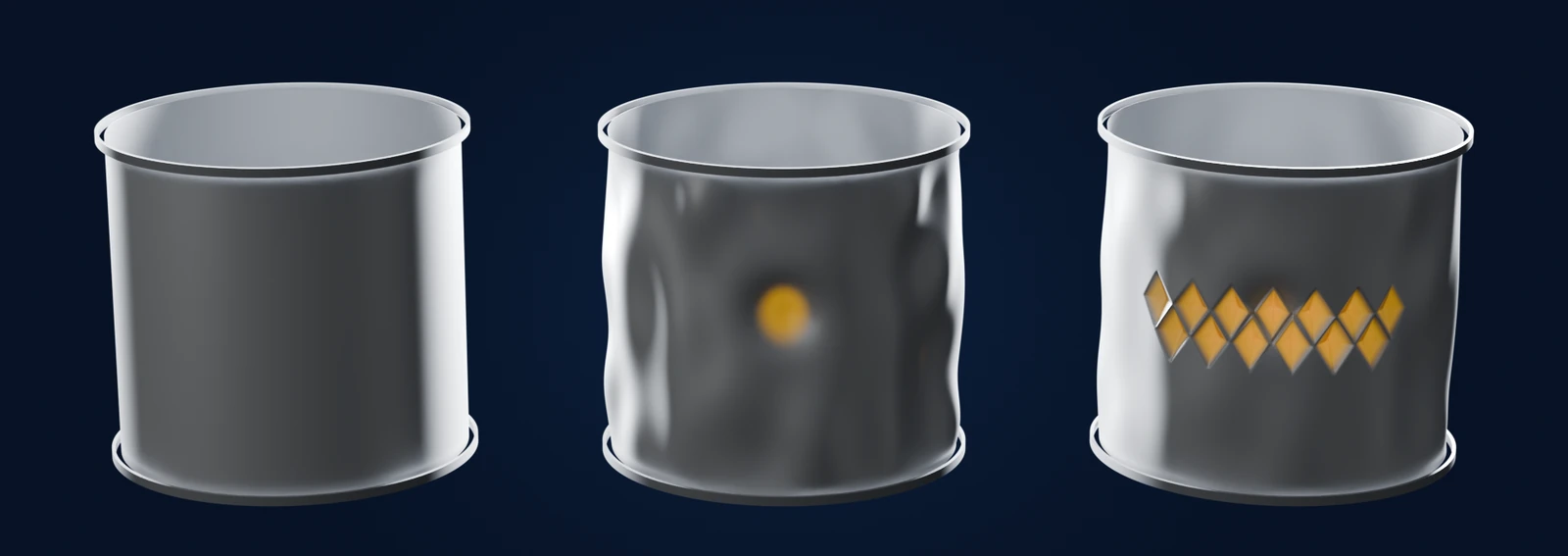
Small geometric deviations (weld distortion, out-of-roundness, dent) drive shells far below their classical buckling limit. MDC reads the knockdown at your imperfection amplitude w/t.
Why this matters
Real shells are never perfectly cylindrical. Weld shrinkage, plate rolling tolerance, transport-induced ovality, and fabrication-stage dents all contribute a characteristic imperfection amplitude. Classical elastic buckling predictions assume a perfect geometry and therefore overstate the collapse load of thin shells, often by a factor of two or more.
The knockdown is not linear in the amplitude: it drops steeply for the first fraction of a wall thickness and declines more gently after that. Designing without mapping this curve means accepting either unquantified over-design or unquantified risk.
How MDC handles it
With Professional, the Knockdown Curves Explorer sweeps w/t from the perfect shell upward and plots the knockdown response, and a measured scan of a cylinder can be classified against the EN 1993-1-6 fabrication tolerance classes (A excellent, B high, C normal) and turned into the amplitude w/t — so you read the knockdown at your actual tolerance level, not at a single idealised value.
The framework is fitted to Skalnav FE Monte-Carlo campaigns and checked against curated collapse tests (2,000+ in the Validation Hub), and the design basis (Mean, or B- and A-Basis with Professional) is selectable.
Try it on your own shell.
Open Skalnav, change the imperfection amplitude w/t and watch the MDC knockdown follow it.